
Case study / CHAD: Galactic Mining Empire
How two trailer angles helped CHAD reach nearly 10% CTR
How two short trailers turned mostly static game assets into distinct world-building and progression pitches for a pre-registration campaign.
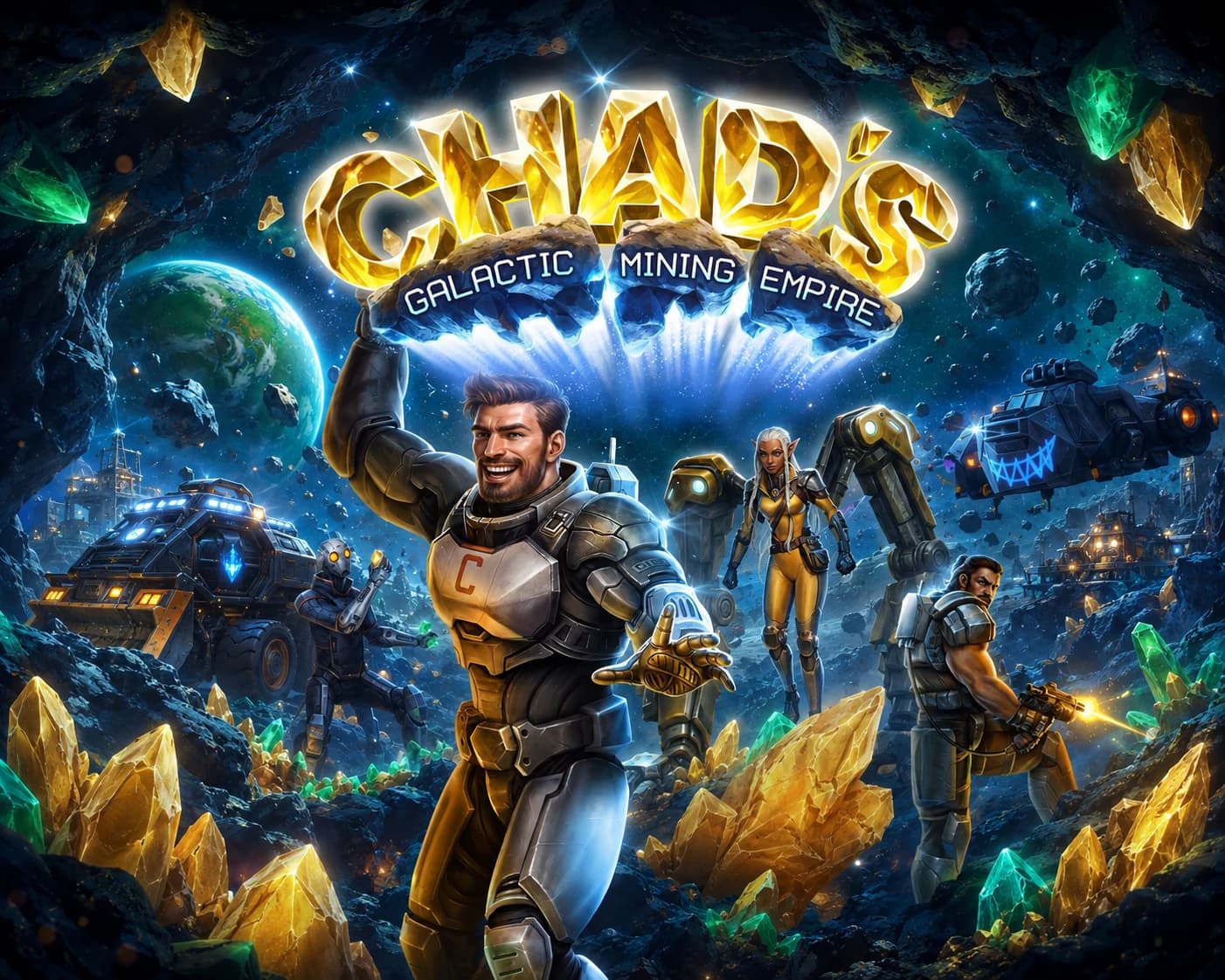
Octocube Games was preparing the pre-registration campaign for CHAD: Galactic Mining Empire when I reached out to them.
They needed creative that could show a bit of everything in a very short window. CHAD has mining, equipment, resources, upgrades, characters, crafting, trading, progression, and a larger sci-fi world around all of it.
The problem was not finding enough things to show. It was deciding how to make those systems understandable without turning the trailer into a list of menus.
We produced two short trailers for the same campaign, each built around a different reason to care about the game. According to Octocube Games, the campaign reached nearly 10% click-through rate and generated close to 30,000 pre-registrations over roughly 30 days.
The challenge
Octocube described the original goal simply:
We wanted to boost our pre-registration campaign with a trailer of the game that showcased a bit of everything.
That sounds straightforward until every feature starts competing for the same 30 seconds.
Mining is only the beginning. Players collect resources, improve equipment, strengthen their character, unlock systems, craft materials, trade, and gradually build a much larger galactic mining operation.
Giving every feature equal attention would make the creative difficult to follow. Instead of treating the game like a checklist, we created two different ways into it.
Trailer 1: Sell the world
The first trailer leans into the world, characters, and overall fantasy of CHAD.
It opens with the idea of being exiled from New-Terra, then moves through the characters, the mining empire, progression systems, and the wider sci-fi universe around the game. Context comes before explanation: there is a world, there are characters, and there is a reason the player is here.
Much of the source material consisted of static game art, character illustrations, interface screens, and existing visual assets. The energy therefore had to come from the production itself.
We combined those assets with AI-assisted animation, camera movement, compositing, transitions, typography, particles, VFX, editing, and sound design. The goal was not to imply that the game contained cinematics it did not have. It was to give the existing artwork enough motion and presentation value to communicate the world effectively in video.
Trailer 2: Sell the progression
The second trailer takes a more direct approach. It starts with the core fantasy - Mine Across the Stars - then immediately shows what players do:
- use mining equipment
- extract rare resources
- improve character attributes
- trade materials
- unlock abilities and upgrades
CHAD contains detailed interfaces, but a new player does not need to understand every percentage, resource value, or upgrade number inside a short ad. They need to understand what those systems mean.
You mine. You find better resources. You upgrade. You become stronger. You unlock more. Your operation grows.
The trailer translates the depth of the game into a progression loop that can be understood almost immediately.
One game, two entry points
Producing two trailers was useful for more than simply having more content. The videos gave players different reasons to become interested in the same game.
The first gave more attention to the world, characters, premise, and fantasy. The second focused on mining, resources, upgrades, and progression.
Neither angle was invented for the ad. Both already belonged to CHAD. The trailers simply separated those selling points so each one had room to land.
That can be more informative than producing several creatives that only change the first few seconds or swap one line of copy. A game can have several genuine appeals. Distinct creative angles let a campaign learn which one resonates.
Turning static game assets into video
Static assets do not automatically become effective video ads, but they can provide strong raw material.
For CHAD, that material included character art, items, game UI, screenshots, logos, and environmental assets. We used AI-assisted motion where it helped, then shaped that motion with traditional production techniques:
- shot selection and composition
- camera movement and timing
- typography and transitions
- layering, particles, and visual effects
- music, sound effects, and sound design
The generated movement was one ingredient. The finished trailers still depended on deciding what each scene should communicate and how every scene should work with the next.
Generating motion is not the same thing as building a trailer.
Why sound design mattered
Octocube specifically highlighted the sound design in its feedback.
That mattered because many of the visuals began as static assets. Sound made the new movement feel more physical: transitions felt faster, impacts felt heavier, item reveals became more noticeable, and camera moves felt more deliberate.
Sound design was not a finishing layer added after the edit. It was part of what made the animation convincing.
The campaign
Octocube used both trailers in a pre-registration advertising campaign that ran for approximately 30 days with roughly $10,000 in media spend.
We had a clickthrough rate of nearly 10% on that campaign, albeit it was a smaller campaign of around 10k USD over a period of 30 days.
The client also reported:
The campaign did really well and ended up giving us close to 30k pre-registrations.
For a campaign designed to build momentum before launch, those were strong signals.
What nearly 10% CTR means
CTR is the percentage of ad impressions that produce a click. At a simple level, 10% CTR means roughly 10 clicks for every 100 impressions.
Platforms can define and report clicks differently, so this number should not be treated as a perfect apples-to-apples benchmark against every other campaign. It is still a useful signal that the creative earned enough interest for viewers to take the next step.
What the trailers did - and did not prove
Two trailers did not single-handedly cause 30,000 people to pre-register.
Creative is one part of a user acquisition campaign. We did not control the media buying, targeting, bids, campaign structure, budget allocation, landing-page conversion, or the rest of Octocube's funnel. The game itself also had to convince people after they clicked.
What we controlled was the creative people saw before making that decision. The trailers had to take a game with many interconnected systems and communicate enough value, quickly enough, for someone to want to learn more.
The nearly 10% CTR is the clearest client-reported signal of how well the ads performed that job. The close to 30,000 pre-registrations describes the result of the overall campaign.
By the numbers
Client-reported campaign results:
- 2 short trailers produced
- ~$10,000 campaign spend
- ~30 days campaign duration
- Nearly 10% click-through rate
- Close to 30,000 pre-registrations
These are overall campaign figures provided by Octocube Games, not a controlled attribution study comparing the individual performance of each trailer.
The playbook lesson
CHAD offers two lessons for other game marketing projects.
First, static assets do not have to result in static advertising.
A studio may not have animated cinematics ready for marketing. Character illustrations, gameplay screens, UI, items, environmental art, logos, and key art can still be enough raw material when motion, editing, typography, compositing, VFX, and sound are all serving a clear message.
Second, one game does not need to be sold through one message.
CHAD could be introduced as a sci-fi world filled with characters and story. It could also be introduced as a deep mining and progression game. Instead of forcing both ideas to compete equally inside one creative, we built a separate entry point for each.
Same game. Different reasons to care.
From Octocube Games
After the project, Octocube highlighted the combination of competitive pricing, fast production, strong iteration, independent execution, visual design, and sound design.
Good at iterations.
Works well alone with few guidelines.
Their final description of the work captured the goal:
Same quality as a multi-man studio.
The client should bring the deep knowledge of the game. Quadral should be able to turn that knowledge into creative without requiring every production decision to be managed for us.